

1. Understand Your Audience
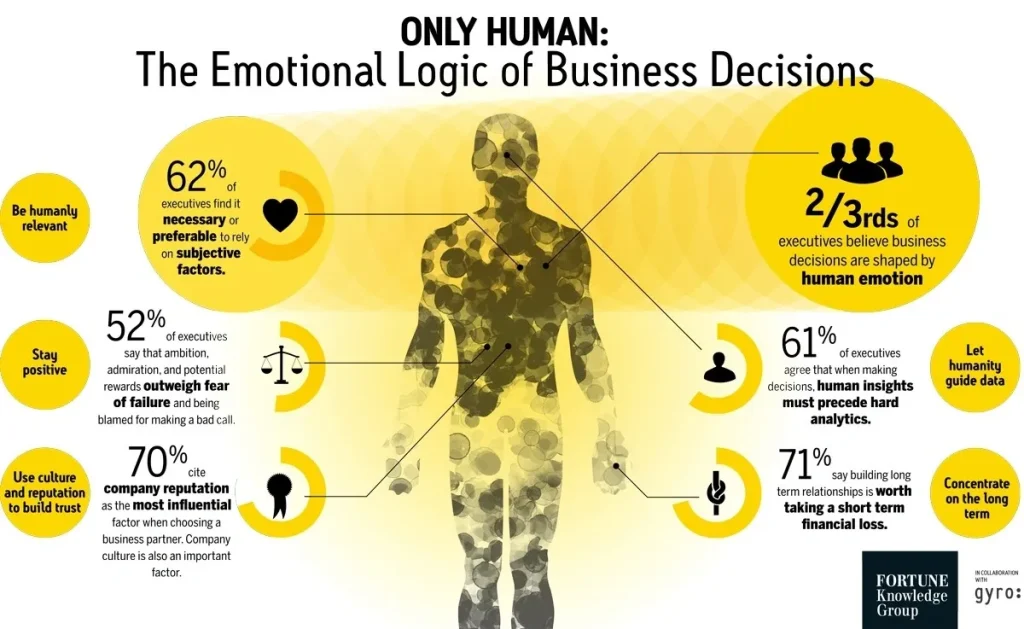
We feel that we could make better choices if it weren’t for how our passions distort the process. The opposite can be true IF we first understand emotions.
Imagine a world where we don’t have passions to drive us? How paralyzed and muted would life be? Yet, we are quick to dismiss emotions in decision making. Now, I am not saying that the WHOLE decision making journey is to be driven by gut…rather we should allow intuition be the guide post of how to narrow a field of choices.

Example: There is no metric for you thinking like a consumer, because you are you…and you buy the things you like. CPG firms follow data that suggests the need to have a label on their product that is eye catching.
The consumer in us looks at the label on the left water bottle as disorder, and we judge this product as defective because the symmetry is off. The product may be fine, and you can send it to a lab, after you purchase it, to test for quality before you drink it, which would generate solid data to inform trust. But this doesn’t make fiscal sense:
Bottle of water: $1.00
Testing at a lab: $650
Shipping to lab: $25
Total investment into purchasing decision: by $676 for a bottle of water
Unless you have a history (or documented history of someone else) who purchased a bottle of water with this type of label, and consumed it with negative physical outcomes, it is illogical to assume it is a bad product. So, why don’t we buy it? Because something just feels off about it, and we naturally just don’t trust it…but what is it that makes us “feel” off?? Our Limbic Brain and our gut!
Our Limbic Brain:
Recall your favorite color…why is it your favorite? Likely the answer is as unexplainable as the water bottle exercise above… other than you “just know” that your favorite color makes you feel comfortable or you are just drawn to it like a moth to a flame. This isn’t your brain making a choice of a favorite, rather it is your nature being expressed through emotions. Our brain, by design, uses awareness to look for options but what it cannot do is make a decision. The amazing library of information and CPU in our heads – which fires our bodies – is incapable of choosing. Rather, it is the primitive, emotional, endocrine system who chooses. It is the endocrine system that controls all of our hormones, and the Limbic Brain is kind of like the endocrine system’s business partner – where part of its job is interpreting your “feelings” into a “choice” or “your truth.”
The hormone serotonin signals the feeling of “comfort” with your favorite color, your favorite song, your favorite memory, or it signals something just feeling “off.” While serotonin operates as a neurotransmitter (brain and nervous system dot connector), it is indeed a hormone 🤯. Ninety-five-percent of the chemical messenger hormone serotonin is produced in the gut, and is believed to contribute to feelings of “well-being” or “happiness.” So, to say that you are being drawn to a certain packaging (like the water bottles above) is a “gut reaction,” is quite literally the case.
Next Time:
The next time you are in a meeting with your team about an important choice to be made, don’t discount your gut, rather, find a way to validate your emotions through data gathering exercises. Your gut might just be right, but give your brain a break the next time you find yourself unable to choose. Pro tip: Maybe grab a piece of chocolate to stimulate your pal th
e endocrine system, because chocolate increases serotonin production. Also, be comfortable acknowledging that your personal bias might just be a small percentage of the group…and that is ok. You aren’t wrong – you might just represent a smaller sample size. Cheers!
